
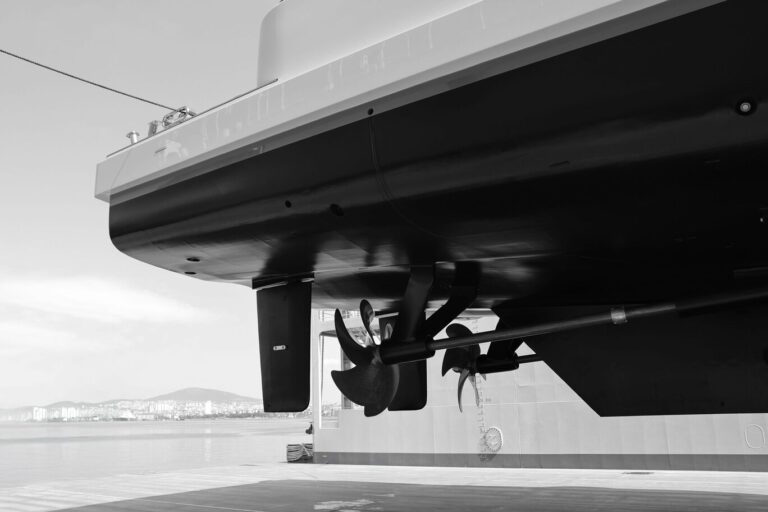
Boat Propeller Cavitation: How to Identify It and What to Do
When cavitation occurs on a boat propeller, the first symptoms are often a loss of performance, increased fuel consumption or unusual vibrations. Many shipowners notice that something is wrong before they are able to identify the source of the problem. Cavitation occurs when vapor bubbles form around the propeller and collapse on its surface. Although we have already discussed this process in depth in our article on marine cavitation, here we focus specifically on how it affects marine propellers, its consequences and the solutions available to correct it.
Most common causes of cavitation on the propeller of a boat
The cause of propeller cavitation is rarely related to a single factor. In most cases, the problem appears by a combination of design, operation and state of conservation of the propeller.
Correctly identifying the cause is essential to implementing an effective solution and to prevent further damage. Factors such as the geometry of the blades, the pitch, the diameter or the materials used for the manufacture of marine propellers can directly affect the behavior hydrodynamic propeller and in the appearance of phenomena of cavitation.
Incorrectly sized propeller for the engine or hull
One of the most common causes is incorrect selection of the propeller with respect to the power of the engine or the characteristics of the hull.
This can occur from the initial design of the ship or after a subsequent modification of the propulsion system. If the propeller is not prepared to properly absorb the available power, you increase the chances of occurrence of cavitation, and other problems associated with the performance.
Operation outside the design envelope
The propellers are designed to work within certain ranges of speed, load and revs.
When the boat is operated routinely out of these conditions, the propeller may be subject to efforts for which it was not optimized. This scenario favors the emergence of the cavitation and accelerates the deterioration of its surfaces.
Wear or damage accumulated on the blades
The passage of time, the impact or corrosion may alter the original geometry of the blades.
Even small deformations can modify the flow of water around the propeller and foster the emergence of areas where it produces cavitation. Therefore, regular inspections are critical for damage before they affect the overall performance of the system.
Incorrect installation or disturbance of the flow
The position of the propeller with respect to the hull also has a direct influence on its operation.
An insufficient distance to the hull, the presence of appendices nearby or certain perturbations of the flow can generate favorable conditions for the cavitation. In these cases, the problem is not necessarily in the propeller, but in how it interacts with the set of the boat.
Signs and effects of cavitation on ship propellers
When the cavitation is not detected in time, their consequences can be extended progressively to the entire line of propulsive.
The main effect of the cavitation in propellers is not only the superficial deterioration of the blades, but also the loss of efficiency and increased operating costs.
Erosion and pitting on the blades
The cavitation generates repetitive impacts on the metal surface of the blades.
Over time, small pits can develop and progressively evolve into larger eroded areas. A blade affected generally have a rough surface and irregular, especially near the leading and trailing edges.
Although the damage may seem initially reduced, can significantly alter the behavior hydrodynamic propeller.
Loss of thrust and increase in consumption
As the geometry of the propeller degrades, diminishes their ability to generate thrust efficiently.
As a result, the motor needs to consume more energy to maintain the same speed of navigation. This effect cavitation in the propellers have a direct impact on the operating costs and can reduce the autonomy of the vessel.
Vibrations and damage to the drivetrain
The cavitation is often accompanied by vibrations anomalous that are transmitted through the propeller shaft.
These vibrations can affect progressively bearings, couplings and other mechanical components. If the problem persists for long periods, there is a risk of structural damage and repairs of high cost.
Impact on the vessel’s acoustic signature
The generation of noise is another consequence of habitual of the cavitation on propellers. This aspect is especially important in fishing vessels, vessel offshore or military applications, where the signature acoustics can directly affect the operational or the fulfillment of certain technical requirements.
Solutions to correct the cavitation on the propeller on your boat
Correct the cavitation requires you to first identify the actual source of the problem. Not all situations can be resolved with a simple replacement of the propeller.
In many cases it is necessary to analyze factors such as the design, state of conservation and the characteristics of ship propellers, since these elements have a direct influence on the water flow, the efficiency of the propulsion and the appearance of phenomena of cavitation.
Inspection and prior diagnosis
Before intervening, it is essential to perform a complete inspection of the propeller and analyze the operational data of the vessel.
During the diagnosis should be reviewed aspects such as:
- surface Condition of the blades.
- Geometry and deformations.
- History of vibrations.
- Regime normal operation.
- Consumption and performance.
Only after this evaluation, it is possible to determine the most appropriate solution.
Repair or reconditioning of blades
When the damage is limited, a repair specialist can return to the propeller, a large part of their benefits originals.
These interventions enable you to recover the geometry of the design and to reduce the vibrations associated with the wear and tear. However, when the erosion is excessive, or there are deformations important, the replacement is usually the alternative recommended.
Replacement by a propeller correctly dimensioned
In many cases, the true because of the cavitation in the propeller is a designed wrong from the start.
When this happens, install a new propeller with the same features will only play the problem. Therefore, the substitution must be accompanied by a technical analysis that ensures the compatibility between the propeller, engine and hull.
Optimization through engineering and simulation CFD
The tools of simulation CFD has allowed us to study the behavior of the flow around the propeller before you make or change any component.
Thanks to these analyses it is possible to identify problem areas, optimize the geometry and to reduce significantly the risk of cavitation. Currently, this is one of the most effective solutions to fix the problem at its source.
How RICE Addresses Propeller Cavitation
In RICE , we understand that the cavitation is rarely an isolated problem of the propeller. In most cases, is the result of the interaction between the hull, engine, propulsion system and the actual conditions of operation.
Therefore, our approach is based on analysis of the complete system by using advanced tools and engineering simulation CFD. This allows us to identify the source of the problem prior to manufacture, to modify or replace any component.
If you have noticed symptoms associated to the cavitation in helices, our team it can help you to diagnose the cause and define the most efficient solution for your boat.
Frequently asked questions about cavitation on ship propellers
Can I keep operating the vessel if the propeller is cavitating?
Yes, but it is not recommended to do so for long periods. The cavitation can accelerate the wear of the propeller and affect progressively to other components of the propulsion system.
How much damage can cavitation cause if it is not corrected in time?
If you do not intervene, the cavitaciorn can cause severe erosion on the blades, increased vibration, loss of performance and damages on items such as the shaft or the bearings.
Does a new propeller always solve the problem?
No. If the cavitation is related to an error in sizing, improper installation, or operational conditions to be inadequate, replace the propeller without a previous analysis can reproduce exactly the same problem.
How do I know whether the problem is the propeller or the engine?
The symptoms can be similar, so that it is necessary to perform a diagnostic technician. The joint analysis of vibrations, performance, consumption, and state-of-the propeller allows you to accurately identify the source of the problem.