
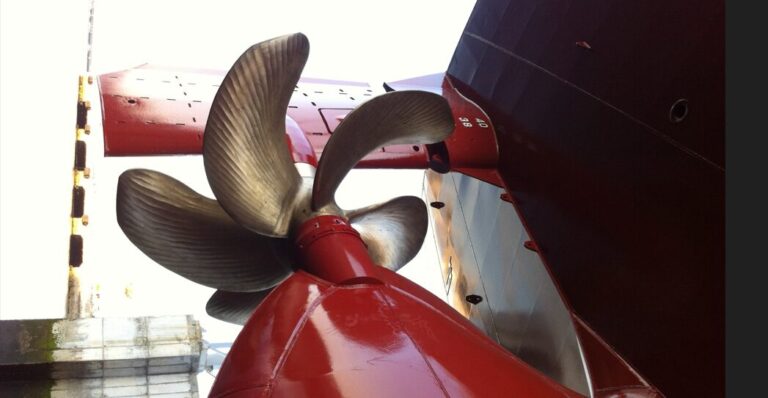
Boat propeller: performance, parts and manufacturing
The a a ship is one of the most important elements of a boat’s propulsion system. Thanks to its design and operation, it allows to transform the power generated by the moving engine, making the ship advance through the water.
Although it may seem like a simple component, the prop is the result of a complex hydrodynamic design that directly influences the boat’s performance, energy efficiency and stability. Factors such as its size, the number of blades or the material of manufacture determine how the ship behaves during navigation.
In this article we explain how a ship’s propeller what are its main parts and how ships’ propellers are manufactured to ensure efficient and safe operation.
What is a boat propeller?
Aa helix de barco es A mechanical device formed by several blades that rotate around an axis to generate thrust in the water. This push allows the boat to move forward or backward.
The propeller is connected to the motor through the propulsion system, usually via a shaft line. When the engine transmits power to the shaft, the propeller begins to rotate and moves water backwards. As a result of this action, a force in the opposite direction is generated that drives the ship forward.
This principle is based on fundamental laws of physics, especially the principle of action and reaction.
How does a boat propeller work?
The operation of a marine propeller is based on the combination of the geometry of its blades and its rotational movement. Each blade is designed with a hydrodynamic profile similar to that of a wing, so that, when turning, it generates a pressure difference between its two faces. This pressure variation accelerates a mass of water towards the stern and produces a reaction force that drives the boat forward.
The process begins when the engine transmits its power to the propeller shaft, which rotates the propeller at the speed intended for each operating regime. During rotation, the blades interact with the water and move it backwards, transforming the mechanical energy of the motor into thrust, the force responsible for the advance of the ship. The magnitude of this thrust depends on the design of the propeller, its diameter, passage and geometry, as well as the hydrodynamic conditions in which it operates.
Hydrodynamic efficiency
The hydrodynamic efficiency of a helix determines the ability to convert the power of the motor into useful thrust with the least possible number of energy losses. An optimized propeller displaces water more efficiently, resulting in lower fuel consumption, higher boat speed and reduced vibration and noise during navigation.
To achieve high performance it is necessary to optimize parameters such as diameter, pitch, geometry of blades and developed area, in addition to controlling phenomena such as cavitation and turbulence. At present, naval engineering uses CFD simulation tools and advanced hydrodynamic models to design propellers that offer maximum performance based on the ship’s characteristics and its actual operating conditions.
Parts of a marine propeller
To better understand its functioning, it is important to know the parts of a propeller. Although there are different designs, most propellers share a similar structure.
Hub or core
The propeller hub is the centerpiece that connects the propeller with the propulsion shaft and is responsible for transmitting the power generated by the motor to the blades. In addition to supporting mechanical loads during operation, it incorporates the necessary elements to guarantee a safe and precise coupling with the shaft, such as the shaft housing, the fixing system and the keyway or locking mechanism used to prevent slippage.
Proper hub design is essential to ensure efficient torque transmission, maintain propulsive assembly alignment, and reduce the risk of vibration, clearance, or mechanical failure during boat operation.
Blades
The blades are the propeller surfaces that interact directly with the water to generate the thrust that drives the boat. Its geometry, dimensions and distribution largely determine the hydrodynamic yield of the propel, since each blade incorporates a profile designed to accelerate the flow of water in the most efficient way possible and minimize energy losses.
The number of blades also influences the behavior of the propeller. the settings of three blades They are the most common to offer a good balance between performance and efficiency, while the Four blade propellers They provide greater thrust, smoother operation and lower vibration levels. In high power applications or with specific requirements for maneuverability and loading, it is common to use Propellers with five or more blades, capable of better distributing efforts and optimizing performance under demanding operating conditions.
Leading edge
The leading edge is the front area of each blade and the first one that comes into contact with the water during the rotation of the propeller. Its geometry plays a fundamental role in the way in which the water flow is distributed around the blade, directly influencing thrust generation, hydrodynamic efficiency and behavior against cavitation.
An optimized leading edge design promotes smooth flow input, reduces turbulence losses, and improves propeller performance over a wide range of operating conditions. On the contrary, an inadequate or deteriorated profile can increase the resistance to advance, generate vibrations and accelerate the appearance of cavitation phenomena.
Exit edge
The exit edge is the back of the blade through which the water leaves the propeller once it has been accelerated during rotation. Its geometry plays a fundamental role in the way in which the water is released from the surface of the blade, conditioning the generation of turbulence and, consequently, the hydrodynamic yield of the propel.
An optimized outlet edge design allows the water to come out more cleanly and evenly, reducing energy losses and increasing propulsive efficiency. It also helps reduce vibrations, noise and cavitation risk, especially important aspects in boats that require a high level of performance and reliability.
Pressure face
The pressure face is the surface of the blade that, during the rotation of the propeller, exerts the force necessary to push the water stern and generate the thrust that moves the boat forward. In this area, a higher pressure is produced than on the opposite face, creating the pressure difference responsible for propulsion.
The shape and finish of the pressure face directly influence the propeller’s ability to efficiently transmit energy to water. An optimized design improves propulsive performance, reduces hydrodynamic losses and helps reduce vibrations and other phenomena that can affect the operation of the boat.
Suction face
The suction face is the opposite surface to the pressure face and is characterized by generating a zone of lower pressure during the rotation of the propeller. This pressure difference between both sides is responsible for producing the hydrodynamic thrust that drives the boat through the water.
The geometry of the suction face is decisive for the performance of the propeller, since it conditions the distribution of pressures on the blade and the behavior of the water flow. An optimized design improves propulsive efficiency, reduces energy losses and helps minimize the appearance of cavitation, one of the main factors that affect the performance and durability of marine propellers.
Root of the blade
The root is the joint zone between the blade and the cube of the propeller, where a large part of the mechanical stresses generated during the torque and rotation transmission are concentrated. Due to the high bending, torque and fatigue loads it supports, this section must have sufficient structural strength to ensure the integrity and reliability of the propulsive assembly.
An adequate root design allows for even stresses to be distributed, reducing the risk of cracks, deformations or structural failures. Therefore, both its geometry and the material used are key factors in ensuring the durability of the propeller and maintaining safe operation even in demanding operating conditions.
Why is the propeller key in the propulsion system?
The propeller does not function as a stand-alone piece, but as one of the main elements of the boat’s propulsion system. Its mission is not limited to generating the necessary push to advance, since it also conditions the energy efficiency, the response of the engine, the maneuverability and the general behavior of the ship during navigation.
When its design is correctly adapted to the engine power, the reduction ratio, the displacement of the ship and the working conditions, the mechanical energy is transmitted to the water with lower losses. This results in better propulsive performance, more content fuel consumption, and reduction of unnecessary loads on the engine and transmission.
Its operation, moreover, is closely related to the axle line, the horns, the supports, the rudder and the geometry of the hull. Any misalignment, vibration or unfavorable hydrodynamic interaction between these components can affect the efficiency and durability of the assembly. For this reason, in naval engineering, the propeller is studied as part of an integrated system, whose balance is essential to achieve efficient, stable and safe navigation.
How are boat propellers made?
Another common question is how are they made propellers of the ships. the manufacture of a HelICE is a process that combines naval engineering, metallurgy and high-precision machining.
Hydrodynamic design
It all starts with the design of the propeller. Engineers analyze the characteristics of the boat to define parameters such as:
- Diameter
- Step
- Number of blades
- Blade geometry
The objective is to achieve the best balance between thrust, efficiency and resistance.
Material selection
The propellers must be manufactured with materials capable of resisting marine corrosion and mechanical loads.
Among the most used are:
- Naval bronze
- Stainless steel
- Wear-resistant special alloys
Each material offers advantages in terms of durability and behavior in water.
Foundry process
Once the design is defined, the helix is manufactured by means of casting in mold. In this process, the molten metal is poured into a mold in the shape of the helix.
After cooling a solid piece is obtained with the basic geometry of the component.
Machining and finishing
After the foundry, the propeller is machined to reach the exact dimensions. The surfaces are also polished to improve the flow of water and optimize its performance.
Balanced
Balancing is a fundamental phase of the manufacturing process. An unbalanced propeller can cause vibrations, premature propulsion wear and loss of efficiency.
Therefore, before its installation, quality controls and tests are carried out to ensure that the propeller works correctly.
The importance of a well-designed propeller
A Well-designed propeller can make a big difference in boat performance.
Among the benefits of an optimized helix are:
- Greater energy efficiency
- Lower fuel consumption
- Better maneuverability
- Vibration reduction
- Longer life of the propulsion system
For this reason, the design and manufacture of propellers are part of a key discipline within naval engineering.
Specialized companies such as RICE, dedicated to engineering naval and supply of marine propulsion systems, work with solutions adapted to each boat to guarantee maximum performance and reliability.
Boat Propeller FAQs
How does a boat propeller work?
A marine propeller works by rotating around an axle connected to the motor. When rotating, its blades push the water back and generate a reaction force that drives the boat forward. This principle allows to transform the power of the motor into movement within the water.
What are the parts of a boat propeller?
They are the hub or core, the blades, the leading edge, the outlet edge, the pressure face and the suction face. Each of these elements influences thrust, hydrodynamic efficiency and propulsion system performance.
How are boat propellers made?
Ship propellers are manufactured through a process that includes hydrodynamic design, metal casting, precision machining, polishing, and final balancing. This process ensures that the propeller has the optimal geometry to generate thrust efficiently.
What material are boat propellers made of?
The boat propellers are usually made from marine corrosion resistant materials, such as naval bronze, stainless steel or special alloys. These materials offer a good combination of mechanical strength, durability and water efficiency.
Why is a suitable propeller for a boat important?
Choose one suitable propeller allows to improve the performance of the boat, optimize fuel consumption and reduce the vibrations of the propulsion system. A well-designed propeller helps make better use of engine power and ensure more efficient navigation.