Which propeller to choose for your boat? How to Choose the Best One
Choosing the right propeller is one of the most important decisions to ensure the performance, efficiency and durability of a boat propulsion system. Many people wonder “How do you know what propeller lead my ship?” If you want to know the answer to it and what propel choose for this when you need replace it or improve the performance of the engine, we show it to you below.
Although it is often thought that it is enough to know the diameter and the pitch of the propeller, there are actually numerous factors that influence their selection..
In this article we explain how to know what propeller use in your boat, the parameters that you must analyze and choose the right propeller for your case.
Why is it important to know which propeller to choose?
The propeller is the element in charge of transforming the power generated by the engine into thrust, turning mechanical energy into movement. Its design has a direct impact on the performance of the boat, as it conditions maximum speed, fuel consumption, acceleration capacity, maneuverability and levels of vibration and noise during navigation.
An incorrect choice can result in a significant loss of performance, increased fuel consumption, cavitation problems, and even premature wear or damage to the propulsion system. Therefore, when the question arises How to choose a boat propeller, It is essential to carry out a joint analysis of the characteristics of the engine, the type of hull, the usual operating conditions and the navigation profile. Only in this way is it possible to select a propeller that guarantees maximum efficiency, reliability and useful life of the propulsive system
How do you know what propeller my boat carries?
One of the most common questionsWhoever has a boat is how to know and what helix takes your boat if it really is the most suitable for your engine and type of Navigation. Identify the HéCorrect Lice not only serves to replace it when it wears, but also to optimize the performance and efficiency of the propulsion system.
To determine which propeller choose or which one currently has your boat installed, it is necessary to review some key elements that allow identifying its main characteristics.
1. Identify the measurements engraved on the propeller
Most of the propellers have two fundamental measures engraved: the diameter and the pitch. For example, a propeller identified as 17 × 19 corresponds to a diameter of 17 inches and a 19-inch pitch. These two parameters are essential to define the behavior of the propel, since they determine both the amount of water that it displaces during its operation and the theoretical advance it makes in each revolution. Its correct interpretation is essential to select a propeller compatible with the boat’s engine, hull and operating conditions.
2. Check the engine model
Marine engine manufacturers usually specify a range of propellers compatible with each model depending on the available power, the maximum speed speed and the type of boat for which it has been designed. These recommendations constitute an excellent starting point for determining which propeller to use, since they guarantee that the engine can work within its intended operating parameters.
3. Analyze current performance
In addition to analyzing the technical specifications, it is important to evaluate how the boat behaves during navigation. Check if the engine reaches the rev rate recommended by the manufacturer, if the boat takes longer than expected to go into glide or if the fuel consumption is higher than expected, it can provide very valuable information about the operation of the propeller.
When these symptoms appear, the installed propeller may not be correctly sized for the combination of engine, helmet and operating conditions. In these cases, reviewing parameters such as diameter, pitch, or even propeller type can significantly improve the performance, efficiency and reliability of the propulsion system.
Key factors in choosing the propeller of a ship
Choosing the right propeller for a boat involves analyzing various technical aspects. Although the diameter and pitch are usually the best known parameters, not the only factors determining the performance of a helix.
In reality, to choose the proper propeller it is necessary to consider other elements related to the design, geometry and configuration of the propulsion system, since they all influence efficiency, The speed and behavior of the boat in the water.
1. Propeller diameter
The diameter of a propeller corresponds to the distance between the opposite ends of the blades and is one of the parameters that most influences its performance. In general terms, a larger diameter allows a greater volume of water to be displaced in each revolution, generating more thrust and being especially suitable for heavy or displacement boats. On the contrary, a smaller diameter usually favors higher speeds in light and fast boats, provided that the rest of the parameters of the propulsive system are correctly sized.
However, the diameter of the propeller cannot be arbitrarily chosen, since it is conditioned by the space available under the hull, the separation from it and by the power that the engine can transmit. Finding the balance between these factors is essential for maximum propulsive performance without compromising the efficiency or reliability of the system
2. Propeller passage
The step indicates the distance that the propeller would advance in a full turn if there were no slippage.
- High pass: higher final speed.
- Low Step: better acceleration and load capacity.
Choosing the right step is key to keeping the engine within its optimal rpm range.
3. Number of blades
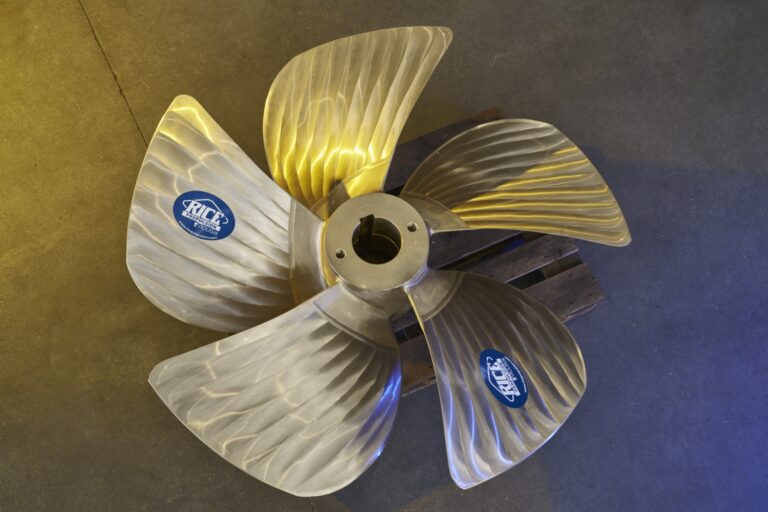
Propellers can normally have 3, 4 or more blades.
- 3 blades: greater speed and efficiency.
- 4 blades: Better grip in the water and greater stability.
The number of blades influences the acceleration, control and vibrations of the system.
4. Propeller rotation
Marine propellers can be designed to rotate right or left, depending on the propulsion system configuration, shaft arrangement and transmission characteristics. The choice of the direction of rotation does not only affect the functioning of the propeller, but also the dynamic behavior of the boat and the distribution of loads on the propulsive system.
In boats equipped with double helix It is common to use counter-rotating propelles, that is, one turn to the right and the other to the left. This configuration allows to balance the effects of torque, improve directional stability, increase maneuverability and optimize the efficiency of the propulsion system, especially during low-speed maneuvers and docking operations
5. Blade area
The developed area of the blades, usually expressed by parameters such as the DAR (Developed Area Ratio) or the Mean Width Ratio (MWR), directly influences the thrust capacity and the hydrodynamic behavior of the propeller. In general terms, a larger blade surface allows more load to be transmitted to water, increasing the thrust available and reducing the risk of cavitation, especially in high-power or load applications.
On the contrary, a smaller blade area decreases the hydrodynamic resistance, which can translate into greater efficiency and better performance at high speeds, as long as the propel continues to be able to absorb the power of the engine without compromising its performance. The selection of the optimal area must balance thrust, efficiency and resistance to cavitation depending on the type of boat and its usual operating conditions
6. Shape and section of the blades
The geometry of the blades directly influences the hydrodynamic performance of the propeller. To define it correctly, parameters such as the profile, the curvature and the thickness of each blade are analyzed, since these determine how the pressures and the loads are distributed during the rotation.
A well-optimized geometry allows for improved propulsive efficiency, reducing energy losses and controlling phenomena such as cavitation. In addition, it must ensure that the blades maintain the structural strength necessary to work safely under the expected loading conditions.
7. Skew angle
The angle skew It is the inclination of the blades with respect to the axis of the propeller.
This design helps:
- Reduce vibrations.
- Improve behavior under certain navigation conditions.
8. Thickness of the blades
Thickness affects the structural strength of the propeller.
- Thicker blades: higher mechanical resistance.
- Thinner blades: better hydrodynamic efficiency.
9. Shaft diameter and mounting system
To install a propeller correctly, it is also essential to verify its compatibility with the propulsion system. To do this, aspects such as the diameter of the shaft, the wedge system and the diameter of the hole must be checked, since these elements guarantee a precise coupling between the propeller and the propeller shaft.
A properly sized installation ensures efficient transmission of power, prevents clearances or misalignments and contributes to reduce vibration, premature wear and potential failure in the propulsion system.
How to choose the right propeller according to the type of navigation
In addition to the technical characteristics, the use of the boat also influences whathe hheLICE eleGgo.
Recreational navigation
For pleasure boats it is usually search:
- Good balance between speed and consumption.
- Smooth navigation.
- Low vibration level.
In these cases, propellers are usually used three blades with medium step.
Work boats
Professional boats require:
- Higher thrust.
- High reliability.
- Load capacity.
That’s why they usually use propellers with greater blade area and lower pitch.
High speed boats
When the priority is the maximum speed:
- Propellers are used with Big step.
- Optimized designs to minimize resistance.
Signs that you need to change the propeller
If you are not clear about what propeller to use, one of the best ways to detect it is to analyze the behavior of the boat during navigation. When the engine does not reach the manufacturer’s recommended rev rate, the maximum speed is reduced, vibrations or fuel consumption is higher than expected, the propeller is probably not correctly sized. The appearance of cavitation phenomena is also a common sign that the propel is not working in optimal conditions.
Although these symptoms may have other causes, in many cases they indicate that the installed propeller is not the most suitable for the combination of engine, helmet and operating profile, or that it has wear or damage that affects its performance. A technical analysis of the propulsive system will allow to determine if it is necessary to modify parameters such as the diameter, the passage or even replace the propeller with a more suitable model.
The importance of consulting specialists
Although it is possible to analyze some parameters on your own, the selection of the ideal propeller usually requires a complete technical study of the propulsion system. To make a precise decision, it is not enough to know the diameter or the step: it is also necessary to assess how the propeller, the engine, the axle and the hull itself interact in real operating conditions.
In this process, having the support of specialists makes a difference. On RICE, as experts in boat propulsion systems, aspects such as:
- Hull features.
- Engine power.
- Axle and rudder system.
- Operating conditions.
This analysis allows you to determine more precisely What propeller choose In each boat, with the aim of improving performance, optimizing efficiency and ensuring reliable operation of the propulsion system.
Frequently Asked Questions on How to Choose a Boat Propeller
How do you know what propeller my boat carries?
You must review the measurements recorded on the propeller itself, where the diameter and step are normally indicated. These figures allow you to identify their main characteristics. You can also refer to the engine manual or propulsion system documentation to confirm the installed model.
How to know which propeller to choose for my boat?
It is necessary to take into account factors such as engine power, the weight of the boat, the type of navigation and the revolution range recommended by the manufacturer. Analyzing these aspects allows eleturn a propeller whate Offer good performance and efficiency.
What if the propeller is not correct?
An incorrect propeller can lead to loss of speed, increased fuel consumption, vibration, or cavitation. Also, you can do whate the motor does not work within its optimal range of revolutions, whate affects the overall performance of the boat.
When is it necessary to change the propeller?
It is advisable to change the propeller when damage, deformation or wear whatand affect its operation. It may also be necessary to replace it if the boat does not reach the right revs or if it seeks to improve the performance of the propulsion system.